Small and mid-sized business leaders often express excitement about AI, drawn by headlines touting agentic workflows, intelligent document processing, and automation that frees up teams by 20+ hours weekly. Yet a common pattern surfaces in their operations: the foundational audit of data, processes, and team skills has been overlooked. Without it, AI pilots frequently fizzle out, wasting budgets and fueling frustration that “AI isn’t ready for real businesses yet.”
That’s where an AI readiness assessment comes in. It’s not a buzzword checklist or a sales gimmick. It’s a practical diagnostic tool that maps your current state against what successful AI adoption requires. Think of it as the pre-flight check before launching your automation roadmap. In this post, we’ll break down what it really involves, why it’s non-negotiable for SMBs like yours, and how it sets you up for quick, measurable wins.
What Exactly Is an AI Readiness Assessment?
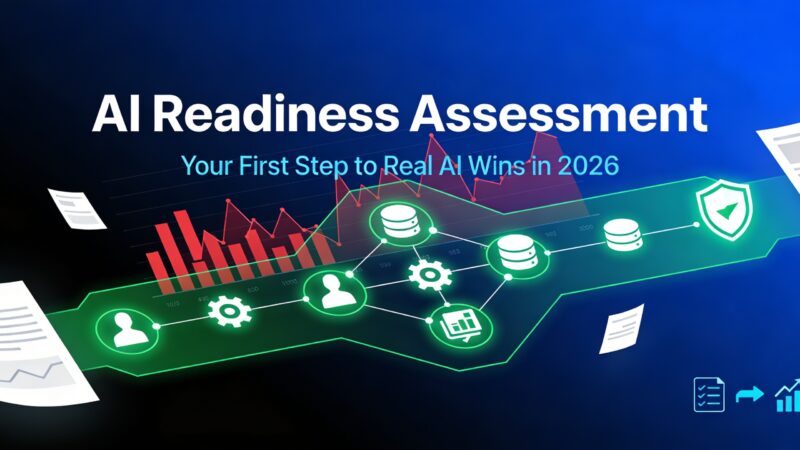
At its core, an AI readiness assessment is a structured evaluation of five key pillars: strategy, data, people, technology, and governance. It scores your maturity in each area, usually on a scale from beginner (ad-hoc experiments) to advanced (scaled orchestration). For example, it might reveal that your invoicing process is primed for intelligent document processing (IDP)—pulling data from PDFs automatically—but your siloed CRM blocks the handoff.
Unlike vague consulting reports, these assessments are actionable. They deliver a maturity score (say, 4/10 overall) and a prioritized list of quick wins. A typical framework looks like this:
- Strategy Alignment: Does your AI vision tie to specific goals, like cutting onboarding time by 50%? Or is it “try some AI tools”?
- Data Foundations: Are your documents and operational data clean, accessible, and governed? Poor data quality kills 80% of AI projects.
- Talent and Culture: Can your ops team prompt AI effectively and spot errors? Or do they fear it as “job replacement”?
- Technology Stack: Do you have integration-ready systems, like MCP as the secure plumbing between AI models and your apps?
- Governance and Ethics: Policies for data privacy, bias checks, and ROI measurement in place?
This isn’t theoretical. We’ve used these assessments to uncover that 70% of teams overestimate their data readiness.
Why It’s the Most Important First Step
Skip the assessment, and you’re building on sand. Industry stats back this up: 90% of AI initiatives fail not from bad tech, but from overlooked basics like misaligned expectations or data silos. In 2026, with hyperautomation trends accelerating, the gap widens. SMBs that assess first see 3x better ROI because they focus on feasible pilots, not flashy demos.
Consider the alternative. Without it, you chase “cool” tools like chatbots that generate reports no one trusts. With it, you target high-impact workflows: IDP for contracts (90% error reduction), AI agents for client triage, or predictive analytics on sales pipelines. It debunks myths we’ve covered before—”AI builds itself” or “it’s free labor”—by grounding plans in your reality.
For solopreneurs and growing teams, the stakes are higher. You can’t afford enterprise budgets for trial-and-error. An assessment delivers a 90-day roadmap: Days 1-30 for baselines, 31-60 for one pilot, 61-90 for scaling. It turns hype into execution, aligning with the roadmaps and myth-busting from our earlier posts.
Real-world proof? A coaching firm we assessed moved from fragmented Google Sheets to automated onboarding, reclaiming 15 hours weekly. No PhDs needed—just clear gaps closed systematically.
Common Pitfalls and How to Spot Them Early
Readiness assessments shine by flagging blind spots. Here’s a quick self-audit table to get you thinking (score 1 point per “yes”):
| Pillar | Key Question | Your Score |
|---|---|---|
| Strategy | AI goals linked to 2-3 KPIs (e.g., time saved)? | Yes/No |
| Data | 80% of key docs digitized and searchable? | Yes/No |
| People | Team trained on basic prompting and review? | Yes/No |
| Tech | At least one system API-ready for automation? | Yes/No |
| Governance | Policy for AI data use and privacy? | Yes/No |
Under 3 points? You’re beginner-level—perfect for a quick pilot like email triage. 4-5? Intermediate: layer in IDP. 6+? Advanced: orchestrate multi-step workflows.
Pitfalls we see often:
- Shadow AI: Teams using unregulated tools, risking compliance.
- Data Debt: Legacy files that frustrate modern intelligent processing.
- Skill Gaps: Leaders assuming vendors handle everything.
An assessment quantifies these, often with visuals like radar charts showing imbalances.
From Assessment to Action: Your 90-Day Path
Once scored, you get a tailored plan. Beginner teams start with low-hanging fruit: automate one repetitive task. Intermediate? Integrate MCP-like layers for safe AI-business handoffs. Advanced? Build agentic systems that decide and act.
This mirrors the 90-day frameworks we’ve discussed—choosing pilots, measuring baselines, iterating. It’s how SMBs leapfrog bigger firms bogged down by politics.
Ready to Benchmark Your Business?
AI isn’t magic; it’s engineering on your foundation. That’s why every client starts with a readiness assessment—it ensures we’re solving real problems, not hypothetical ones.
Take ANSA Solutions’ free AI Readiness Assessment today. In minutes, you’ll get your personalized score, gap analysis, and 90-day roadmap—customized for operations streamlining and intelligent document processing. No sales pressure, just clarity to fuel your growth.
What’s your biggest AI hesitation right now? Drop a comment—let’s chat.