Author: <span>Sundaresh Ramanathan</span>

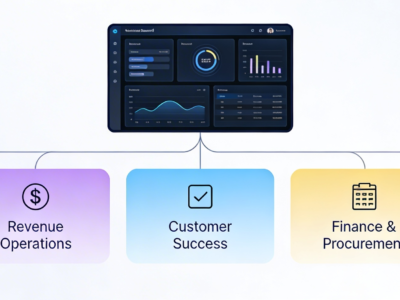
Illustration of a central AI automation platform with five labeled accelerator tiles—Meeting Transcript Aggregator, Revenue Operations, Customer Success, Finance & Procurement, and IT & Security Operations—connected in a clean, modern dashboard layout.

Automation Accelerators: The Safest Way to Try AI in Your Business

AI automation accelerators are pre-built, extensible solutions that let you pilot AI in high‑impact workflows—like meetings, revenue operations, customer success, finance, and IT—without committing to a risky, time‑consuming “big bang” project. They run on a common automation platform, so once your first accelerator is live, you can keep adding new ones or even build custom accelerators on the same foundation, turning early wins into a scalable automation ecosystem across your business.

Business leader reviewing a simple AI and automation roadmap with a small team in a conference room.

A Practical Roadmap for Your First AI and Automation Pilot

Many small and mid-sized business leaders feel pressure to “do something with AI” but lack a clear path forward. This post offers a plain-language roadmap for launching a focused AI and automation pilot, from clarifying business outcomes to choosing a few high-impact workflows, preparing your data and systems, rolling out in phases, and deciding what to scale. Along the way, we share simple examples like meeting intelligence, client health monitoring, finance automation, and IT digests—plus how we package patterns like these as AI powered automation accelerators you can browse online.

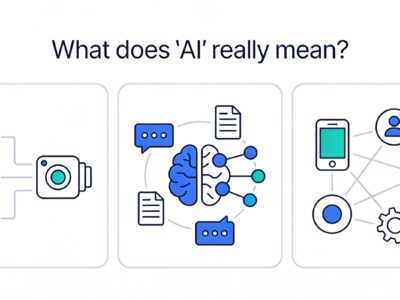
Illustration showing three simple panels that explain different aspects of AI: data flowing into a model, language and documents around a brain, and connected apps with gears for automation.

What does “AI” Really Mean (Without the Jargon)

AI is everywhere in the headlines, but most small and mid sized businesses are still struggling to turn the buzz into real results. This post unpacks what “AI” actually means without the jargon, separating models, machine learning, large language models, and automation into plain language. It also explores the hidden challenges that slow adoption down, from messy data and unclear ownership to vendor hype and employee fears, and gives leaders a simple framework to cut through the fog and focus on concrete outcomes instead of vague AI promises.