
What are automation accelerators?
Most teams are curious about AI but worried about cost, disruption, and the risk of “another big project.” Automation accelerators change that by giving you small, proven, ready‑to‑launch solutions for specific workflows like meetings, revenue operations, customer success, finance, and IT.
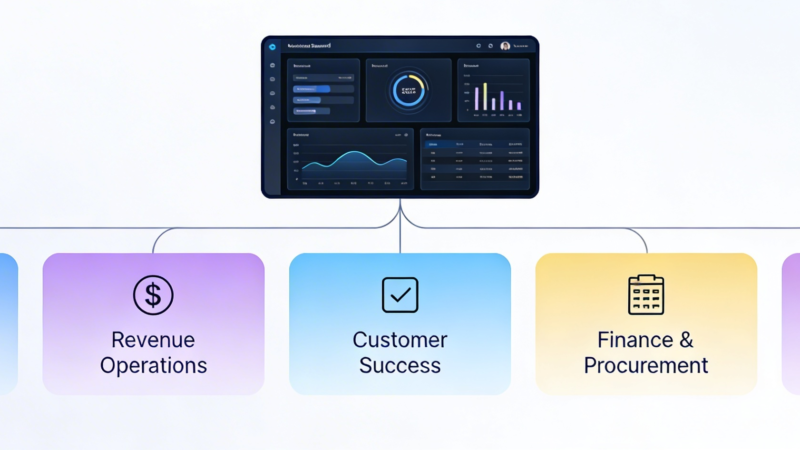
At ANSA, automation accelerators are pre-built, configurable solutions that target a narrow, high‑impact slice of your work:
- Meeting Transcript Aggregator
- Revenue Operations
- Customer Success
- Finance & Procurement
- IT & Security Operations
Each one comes with a bundle of focused workflows (your “key accelerators”) so you can turn on value quickly without rethinking your entire tech stack.
Example 1: Meeting Transcript Aggregator (for all teams & leaders)
This accelerator continuously ingests and processes every client conversation across meeting platforms, then connects that data back to your systems.
Key capabilities include:
- Auto‑ingest transcripts from your meeting tools
- CRM contact matching so conversations tie to the right accounts
- AI summarization and tagging so key topics and next steps are captured
- Email cross‑referencing to connect what was said in meetings to follow‑up threads
- A searchable knowledge index so teams can find “what was said” in seconds
Why it’s low‑risk and fast: you don’t change how teams meet—you simply unlock structured, searchable insight from calls you’re already having.
Example 2: Revenue Operations (for sales & revenue leaders)
The Revenue Operations accelerator focuses on the workflows that make or break your pipeline and renewals.
Key accelerators:
- Meeting Prep – pull context, history, and key signals into one place before a call
- Post‑Meeting Tracker – log outcomes, tasks, and updates without manual data entry
- Deal Risk Monitor – surface at‑risk deals based on engagement and activity patterns
- Lead Enrichment – automatically add missing data to leads for better routing and prioritization
Why it’s low‑risk and fast: you keep your CRM and sales tools, but remove the manual, error‑prone steps that slow reps down and hide risk.
Example 3: Customer Success (for CS leaders)
This accelerator helps CS teams stay ahead of churn and manage larger books of business without burning out.
Key accelerators:
- Client Health Monitor – track key signals and engagement to spot trouble early
- Renewal Alerts – trigger timely outreach for upcoming renewals
- Comms Summarizer – summarize customer conversations for quick context
- QBR Prep – assemble data and insights needed for quarterly reviews
Why it’s low‑risk and fast: it layers intelligence and automation on top of your existing CS stack, making every CSM more proactive without changing their core tools.
Example 4: Finance & Procurement (for finance leaders)
The Finance & Procurement accelerator streamlines financial workflows where accuracy and speed matter most.
Key accelerators:
- Invoice Processing – route, approve, and sync invoices with less manual touch
- Expense Audit – flag unusual or non‑compliant spend automatically
- Contract Monitor – track key dates, obligations, and renewals
- Cash Flow Alerts – notify leaders about cash‑impacting events in real time
Why it’s low‑risk and fast: you’re not replacing your ERP or accounting system—you’re automating the tedious work that surrounds it.
Example 5: IT & Security Operations (for IT directors & MSP ops)
This accelerator focuses on routine IT and security tasks that eat up your team’s day.
Key accelerators:
- Incident Triage – categorize, route, and prioritize tickets faster
- Onboarding/Offboarding – standardize user and access changes across systems
- License Management – monitor and adjust software licenses automatically
- Security Digest – surface key security events and insights regularly
Why it’s low‑risk and fast: it reduces manual effort and response time while sitting on top of your existing ITSM, identity, and security tools.
Extensible by design, not a dead‑end tool
Most purpose‑built AI tools are point solutions: they solve one problem well, but you quickly hit a ceiling when you try to go beyond their original use case. With accelerators, you get something different: an extensible foundation.
- Each accelerator runs on a common automation and integration platform, so you can keep adding new accelerators over time without re‑inventing the plumbing.
- As your needs evolve, your team can build custom accelerators on the same base—reusing connectors, data models, and patterns instead of starting from scratch.
- This turns your first accelerator into the start of a reusable automation ecosystem, not a one‑off project or yet another standalone AI tool.
The result is that you don’t just “try AI once”; you create a scalable way to roll out AI and automation across more teams and workflows as you’re ready.
Why accelerators are the safest way to introduce AI & automation
Across all of these areas, accelerators share a few important traits that make them ideal “first steps” into AI
- Narrow scope, clear value
Each accelerator targets a specific domain and set of workflows, so you can quickly answer, “Did this make life easier?” and “Did we get ROI?” - Minimal disruption
Teams keep using familiar systems like CRM, ticketing, finance tools, meeting platforms etc. while AI and automation quietly handle repetitive tasks in the background. - Proven patterns, not experiments
The workflows and logic are based on repeatable patterns, not one‑off experiments, which reduces implementation risk and uncertainty. - A foundation you can grow on
Once one accelerator is live, you can add more (for example, layering Revenue Operations on top of Meeting Transcript Aggregator) and build a connected automation ecosystem instead of disconnected one‑offs.
If you’ve been waiting for a low‑risk way to try AI in your business, starting with one accelerator—like Meeting Transcript Aggregator or Finance & Procurement—is often the fastest path to real, measurable results.