
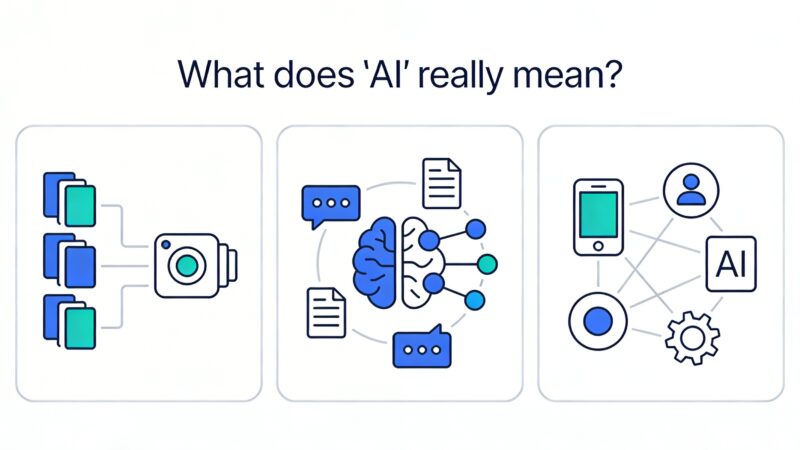
AI is everywhere in the headlines, but under the surface most organizations are still struggling to adopt it in a meaningful way. A big part of the problem starts with the term itself: “AI” means so many different things that leaders end up talking past each other.
What “AI” Really Means (And Why Everyone Gets Confused)
When leaders say “AI,” they are usually mixing together several different ideas. That is why AI conversations often feel fuzzy and people talk past each other.
In simple terms, “AI” is any system that helps your people make better decisions or take better actions by learning from data and patterns instead of only following fixed rules. Inside that broad label sit several building blocks:
- Models
A model is the engine that makes predictions or decisions. You can think of it like a very advanced spreadsheet formula that has been trained on lots of examples so it can recognize patterns and make educated guesses. - Machine learning
Machine learning is how many models are created. Instead of a human writing every rule, you feed the system examples and it figures out the rules itself. This is what powers things like demand forecasts, product recommendations, and risk scores in the background. - Large language models (LLMs)
LLMs are models trained on huge amounts of text so they can work with language. They are behind tools that answer questions in plain English, draft emails, summarize long reports, and chat with users. Think of them as very advanced autocomplete that has learned how people usually write and speak. - Other things that get called “AI”
On top of this, people also use “AI” to describe classic automation (moving data or triggering steps based on rules), computer vision (working with images and video), and speech systems (turning voice into text and back again).
Because all of this gets bundled into one word, one person might be thinking about smarter reports, another about chatbots, and another about full digital workers. For non technical leaders, the key is not to memorize the terms but to keep three questions in every AI discussion:
- Are we talking about background prediction, language and content, or simple automation with smarter rules
- What specific process or problem are we trying to improve
- What data and guardrails does this type of AI need to be safe and useful
Once you break “AI” into these pieces, it becomes much easier to set expectations, pick the right type of solution, and explain to your teams what will actually change in their day to day work.
Why the Broad Term “AI” Causes Problems
Because “AI” is so broad, three issues show up quickly:
- Vague goals
If your goal is “do something with AI,” you are almost guaranteed to waste money. Clear outcomes like “cut onboarding time by 30 percent” or “reply to customer emails within one hour” work better. - Misaligned expectations
Staff worry about job loss, executives expect magic, and teams building solutions feel squeezed in the middle. The word “AI” itself often triggers fear or hype before the real conversation even starts. - Scattered experiments
Without a shared definition, every team runs its own pilots. You end up with many disconnected tools, overlapping costs, and no clear view of what is working.
The Real Challenges With AI Adoption
Once you get past the buzzword, several very practical challenges appear.
1. Data that is not ready
AI is only as useful as the data it can see. Many organizations have:
- Information spread across email, shared drives, and SaaS tools
- Poorly labeled documents and inconsistent fields
- Sensitive data mixed with general data
The result is that AI pilots look good on a clean demo set, then break when faced with messy, real data.
2. Unclear ownership and accountability
AI projects touch many areas at once: IT, operations, legal, HR, and business units. Common questions arise:
- Who decides which use cases to prioritize
- Who owns the budget and signs off on risk
- Who is accountable if an AI system makes a harmful mistake
When this is not clear, AI projects stall in endless discussions or get blocked late by risk and compliance.
3. Fear and change fatigue
Employees have already lived through waves of new tools and process changes. AI feels like another wave, but with higher stakes. Common reactions include:
- Worry about being replaced or judged by a system
- Skepticism that “this will just be another tool we test for a few months”
- Confusion about how their role will change
Without honest communication and involvement, people resist or quietly ignore new AI tools.
4. Vendor noise and confusion
The market is crowded. Almost every tool now claims to be “AI powered.” Leaders face:
- Difficulty telling real capabilities from marketing language
- Overlapping tools that all promise similar outcomes
- Pressure from multiple vendors to “move fast” and lock into their platform
This noise makes it hard to choose a focused, realistic path.
5. Starting too big or too small
Some organizations try to leap straight to “AI everywhere,” which overwhelms teams and infrastructure. Others get stuck on tiny experiments that never connect to core operations.
The sweet spot is to pick a few concrete, high impact workflows and design AI around those, then expand once you have proof and trust.
How Leaders Can Cut Through the Fog
Non technical leaders do not need to become AI experts. They do need a clearer way to frame the conversation. A simple approach:
- Replace the word “AI” with the outcome
Say “faster approvals,” “better forecasts,” or “automatic document processing” instead of “AI project.” - Classify the type of AI work
Is this about automating tasks, answering questions, supporting decisions, or acting as an agent that can take actions - Tie each initiative to a process you already understand
If you cannot name the current process, owner, and pain points, the “AI” idea is not ready yet.
By narrowing the meaning of “AI” to specific outcomes, process changes, and responsibilities, you reduce hype and fear. You also make it much easier to spot the real challenges early and deal with them honestly.